
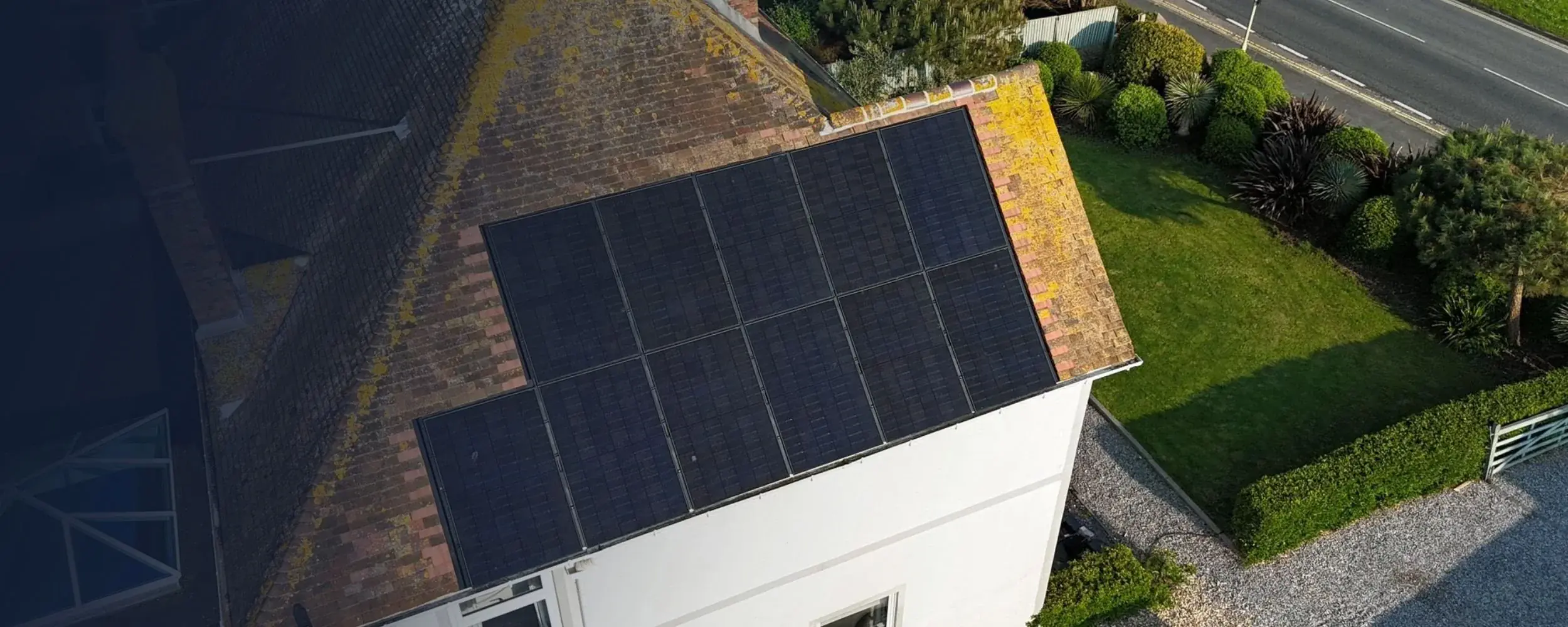
Most UK homes pay £5,000 to £12,000 for solar panels installed in 2026. A 4kW system, the size that suits a typical three-bedroom house, costs £6,000 to £8,500. Adding battery storage puts another £2,500 to £5,500 on the bill.
Below are the prices by system size, what sits inside that number, and how long it takes to earn back.
Solar panel prices by system size (2026)
Prices include panels, inverter, mounting, scaffolding, electrical work, MCS certification and VAT at 0%.
| System size | Panels (approx.) | Roof space needed | Installed cost | Suits |
| 3 kW | 7-8 | 14-16 m² | £4,500 - £6,500 | 1-2 bed, lower usage |
| 4 kW | 9-10 | 18-20 m² | £6,000 - £8,500 | 3 bed, average usage |
| 5 kW | 11-13 | 22-26 m² | £7,500 - £10,500 | 4 bed, higher usage |
| 6 kW+ | 14-16 | 28-32 m² | £9,500 - £13,000 | Large home, EV, heat pump |
These aren't figures pulled from a comparison site. CRG Direct has worked on more than 640 installation sites across the South of England, over 230 of them in the PO postcodes around Portsmouth, Havant, Chichester and the Isle of Wight, with strong clusters through West Sussex, Surrey and Southampton. The ranges above reflect what real roofs in this region actually cost to fit.
What a battery adds
Battery cost tracks capacity, not system size:
| Usable capacity | Added cost | What it covers |
| 5 kWh | £2,500 - £3,500 | Evening use for a small household |
| 10 kWh | £4,000 - £5,500 | Most of a family home's overnight demand |
| 15 kWh+ | £6,000 - £8,000 | Large home, EV charging, off-peak arbitrage |
What you're paying for
| Element | Share of cost |
| Panels | 40-50% |
| Labour and scaffolding | 25-35% |
| Inverter and electrics | 15-25% |
| Materials, certification, sign-off | 5-10% |
Panel type moves the per-kW price:
| Panel type | Cost per kW | Notes |
| Monocrystalline | £900 - £1,400 | Standard choice in 2026. Higher efficiency, 20-30 year warranties |
| Polycrystalline | £750 - £1,100 | Cheaper, needs more roof space for the same output |
| Thin-film | £600 - £900 | Rare on UK domestic roofs |
What pushes your quote up or down
Five things account for most of the variation between two homes of the same size:
- Roof access and height. Three storeys or restricted access means more scaffolding.
- Roof condition. Tiles that need replacing before mounting add cost. A survey catches this.
- Roof pitch and orientation. South-facing at 30-40° generates most. East-west splits work, and often suit households using power through the day.
- Shading. Chimneys, trees and neighbouring buildings may call for optimisers.
- Electrical work. Older consumer units sometimes need upgrading before a system can be signed off.
You pay 0% VAT on domestic solar and battery installs until 31 March 2027, which saves most households £1,000 to £2,000 against the standard rate.
Savings and payback
A 4-5kW system saves most households £500 to £700 a year on electricity, depending on your usage, generation and energy costs. Across all system sizes the range runs £450 to £1,200, driven by how much power you use while the sun is up.
Most UK homes break even in 8 to 11 years. Panels last 25-30 years, so a system installed in 2026 spends roughly two decades saving you money after that point.
Three things shorten payback:
- Using power during daylight hours (working from home, EV charging, heat pump)
- A battery, which cuts how much you buy back at peak rates
- A strong Smart Export Guarantee rate
Solar also lifts property value. Research from the Urban Big Data Centre at the University of Glasgow found homes with solar carry a 6.1% to 7.1% price premium, though any uplift varies by property and local market.
Grants and schemes
You may not pay the full price. Check these before you buy:
- ECO4 funds solar for eligible low-income households, administered through energy suppliers
- Warm Homes: Local Grant covers full installs for some households, delivered by local authorities
- Solar Together group-buying schemes run by councils cut prices by 30-35%
- 0% VAT applies to everyone until 31 March 2027
Eligibility turns on income, property type, EPC rating and location.
Getting paid for what you export
The Smart Export Guarantee pays you for electricity you send back to the grid. Rates run 5p to 15p per kWh depending on supplier. You need a smart meter and an MCS-certified install to qualify.
A battery raises what you earn, because you can hold power and export when rates peak instead of the moment it's generated. See our guide to the SEG scheme for how it works and how to apply.
Will solar work on your roof?
Solar suits more homes than people expect. The ideal is a south-facing roof pitched between 30 and 40 degrees, but east and west roofs still perform well, often better for households using power through the day.
Check three things:
- Shade. Trees, chimneys or a taller neighbouring building cut output. Optimisers recover some of that loss.
- Roof condition. Tile, slate and flat roofs all take panels. An older roof may need repair first, which is cheaper to do before the scaffolding comes down than after.
- Your usage. Match system size to annual kWh, not roof space. Oversizing a system for a low-usage household lengthens payback.
If your roof rules out panels, ground-mounted arrays sit in the sunniest part of a garden instead.
Planning permission
Most domestic solar installs count as permitted development, so you won't need planning permission. Three exceptions apply:
- Listed buildings
- Conservation areas
- Ground-mounted arrays above a certain size
Our planning permission guide covers the detail. Your install still has to meet building regulations regardless. Use an MCS-certified installer: it's a requirement for SEG payments and for most grant schemes, not a nice-to-have.
Choosing an installer
Ask any installer for four things before you sign:
- MCS certification number. Verify it on the MCS register yourself.
- A written breakdown. Panels, inverter, battery, scaffolding and electrical work priced separately, not one lump sum.
- Recent local references. Ask for installs within 20 miles from the last six months.
- Warranty terms in writing. Panel performance warranty, inverter warranty and workmanship warranty are three different things with three different lengths.
Get three quotes. Prices for the same system vary more between installers than most homeowners expect.
FAQs
What does a solar panel installation cost in the UK in 2026? £5,000 to £12,000 for most homes. A 4kW system, suitable for a typical three-bedroom house, runs £6,000 to £8,500 installed.
How much do 10 solar panels cost? Around 4kW of output, so £6,000 to £8,500 installed with 400-450W panels.
Is a 4kW system worth it? For a three or four-bedroom home with average usage, yes. Payback lands around 8-11 years and the system runs for 25-30, depending on your usage, generation and energy costs.
How much does a solar battery add? £2,500 to £3,500 for 5kWh, £4,000 to £5,500 for 10kWh. A battery extends payback slightly but raises annual savings and SEG income.
Is solar still worth it in the UK? Yes, for most homes. Electricity prices have stayed high, export rates have improved, and VAT is 0% until March 2027.
What are the ongoing costs? Little. Occasional cleaning helps output. Budget for one inverter replacement at 10-15 years, around £800-£1,500.
Get a real number for your roof
National averages only take you so far. A survey of your roof, your usage and your export options gives you the actual figure.
CRG Direct is MCS-certified and NICEIC-approved, with over 640 installation sites completed or under way across Hampshire, Sussex, Surrey and the wider South East. Get in touch for a free, no-obligation quote.
Sources
- Urban Big Data Centre, University of Glasgow, the research behind the ~6-7% solar property-price premium (the study found a 6.1%-7.1% premium): How do solar panels affect property prices in the UK?
- HMRC, 0% VAT on energy-saving materials (VAT Notice 708/6, zero rate applies to 31 March 2027): official guidance
- Ofgem, Energy Company Obligation (ECO4): official scheme page
- GOV.UK, Warm Homes: Local Grant: scheme guidance
- Ofgem, Smart Export Guarantee (SEG): official scheme page
- Microgeneration Certification Scheme (MCS): mcscertified.com