
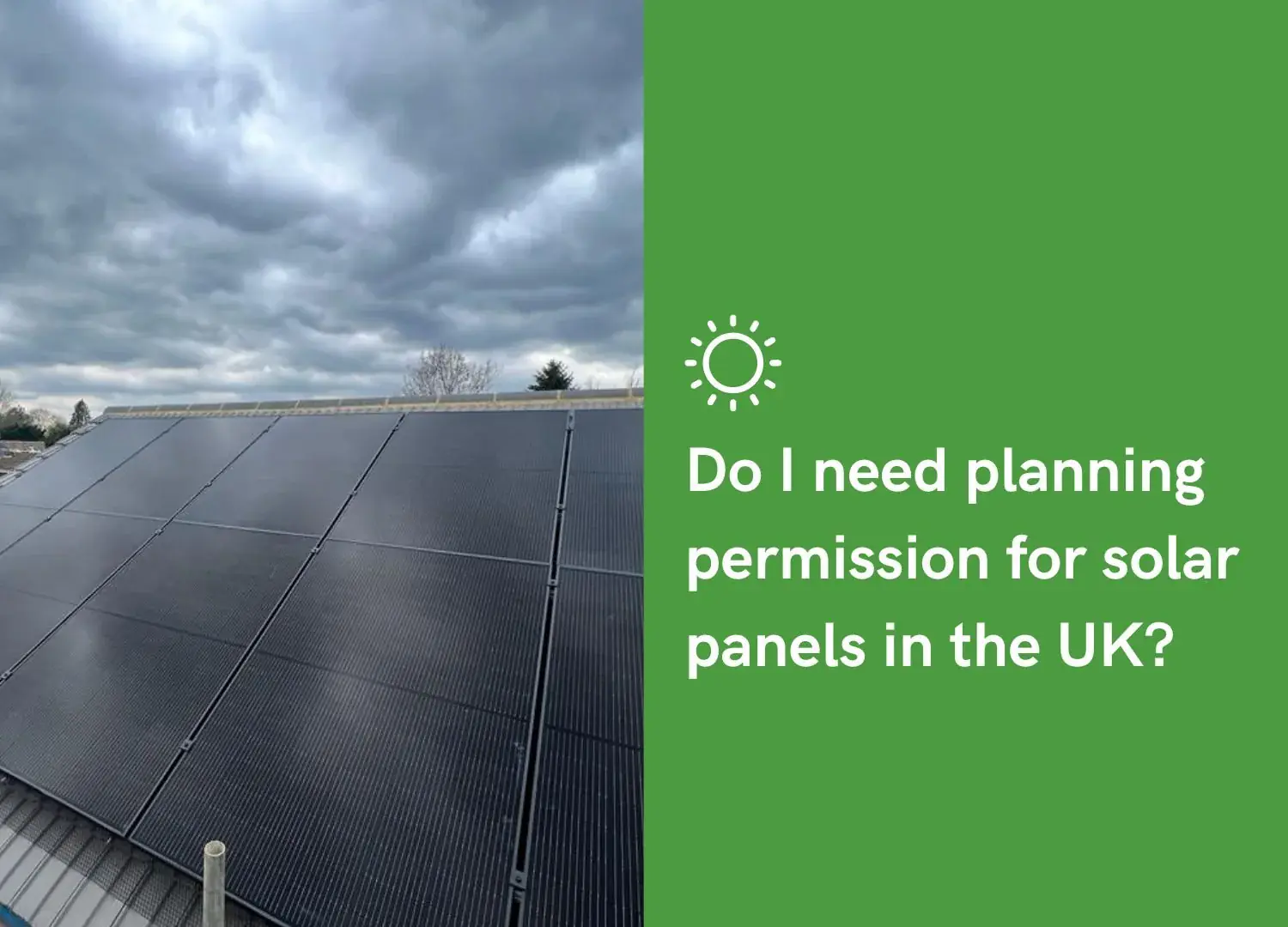
For most UK homeowners, no. Solar panels fall under permitted development rights, which means you can install solar panels without applying for planning permission. Listed buildings, conservation areas, and unusually large systems are the important exceptions. If your home is a standard private house, you can almost certainly go ahead and a well-sized solar panel system will cut your energy bills from day one.
Not sure how to judge an installer? Martin Lewis's advice is covered in what Martin Lewis says about solar panels, including how to check an installer's reviews.
Permitted Development Rights
The government added solar panels to permitted development rights in 2008. Your solar installation qualifies provided it meets these conditions:
- Panels don't protrude more than 200mm from the roof or wall surface
- The installation doesn't exceed the highest part of the roof
- Panels are mounted parallel to the roof slope
- Panels are removed when no longer in use
- The system is installed to minimise the effect on the external appearance of the building
Meet those conditions and you don't need to contact your local planning authority at all. Most rooftop solar panels on pitched roofs qualify automatically.
When You Do Need Planning Permission
Listed Buildings
- Grade I listed: Always requires planning permission and listed building consent
- Grade II* listed: Always requires planning permission and listed building consent
- Grade II listed: Usually requires permission
- Conservation area: Permission required for any installation visible from a highway
- Scheduled monument: Subject to the strictest controls. Contact your local planning authority before proceeding.
If your property is a listed building, contact your local planning authority before doing anything else. English Heritage will likely be consulted, and the impact on the surrounding area and neighbouring land will form part of the assessment.
Flat Roof Installations
Different rules apply to flat roof solar panel installations:
- Panels must sit at least 1 metre from the edge of the roof excluding any chimney or parapet
- Height must not exceed 1 metre above the flat roof surface
- Total solar equipment must cover no more than 50% of the roof area
Ground Mounted Solar Panels
Planning permission is required for ground mounted solar panels if:
- The system covers more than 9 square metres
- Any single dimension exceeds 4 metres
- The installation sits within 5 metres of the property boundary
- Height exceeds 4 metres
Standalone solar panels that fall outside permitted development go to the local planning authority for a full decision. In some cases, prior approval may be needed, particularly for proposed installations in sensitive areas or national landscapes. Property owners should check with their installer before proceeding.
Wall Mounted Solar Panels
Wall mounted solar panels are more likely to require planning permission than rooftop panels, particularly in conservation areas where any change to the external appearance of the building faces greater scrutiny. If you're considering wall mounted panels, check with your local planning authority first. The amenity of the area and the effect on elevation walls will both be assessed.
Commercial Properties
Different rules apply to business premises, agricultural buildings, community buildings, and sites with multiple installations. Systems above 50kW follow a much less prescriptive process focused mainly on design, appearance, and glare impact. Contact your installer or local planning authority early if your site is commercial.
Conservation Areas and National Parks
Local planning authorities have more discretion in these areas. Rooftop solar panels are often still considered permitted development provided they don't protrude more than 200mm from the roof or wall surface, but wall mounted solar panels and ground mounted solar panels are more likely to require planning permission due to their greater impact on the external appearance of the area.
Installations in national landscapes require special consideration to minimise visual impact. Pre-application advice from your local planning authority is strongly advised before committing to a design. World Heritage Sites go further. Individual assessment is standard, visual impact studies may be required, and English Heritage will usually be consulted.
The Planning Application Process
If you do need to apply for planning permission, the process runs like this:
- Pre-application advice (optional but saves time)
- Complete the application form
- Submit supporting documents with detailed information about the proposed installation, including size, location, and potential impacts
- Pay the fee (typically £206)
- Wait up to 8 weeks for a decision
Documents you'll need:
- Location plan at 1:1,250 scale
- Site plan at 1:500 scale
- Elevation drawings showing which elevation walls are affected
- Design and access statement
- Heritage statement (if the property is a listed building or in a conservation area)
The more detail you provide about the proposed installation and its effect on the surrounding area, the smoother the process tends to go.
Building Regulations
Planning permission and building regulations are separate. Even when no planning permission is needed, your solar installation must comply with:
- Structural safety: The roof must support the additional weight of the panels. A structural report may be required to confirm this.
- Electrical safety: Part P regulations apply to all electrical work.
- Weather resistance: Proper sealing at every point where panels meet the roof or wall surface.
- Fire safety: Appropriate materials throughout the panel installation.
It is strongly advised to use an MCS-certified installer. MCS certification means building regulations are handled as standard, notifications are made to the relevant authorities, and you get access to Smart Export Guarantee (SEG) payments for surplus electricity exported to the grid.
Common Misconceptions
"My neighbour complained, so I need permission." Permitted development rights aren't affected by neighbour objections. If your solar installation meets the standard conditions, their view on it has no legal weight. Letting them know beforehand avoids unnecessary friction, but it doesn't change what's permitted.
"I need permission for a battery." Internal battery storage doesn't need planning permission. External installations may need consideration depending on size, but they usually fall within permitted development too.
"Panels must face south." No planning rule requires a particular orientation. East and west-facing panels are permitted. Whether south-facing gives you better output is a performance question. One direction may outperform another, but the planning system doesn't mandate it.
If You Install Without Permission
If you install panels that require planning permission without getting it, your local planning authority can issue an enforcement notice requiring removal. You can apply retrospectively, but the application faces extra scrutiny, a higher refusal rate, and any additional costs fall on you. A quick check with your installer before the project starts takes minutes and removes the risk entirely.
Tips for a Smooth Installation
- Check whether your property is a listed building or sits in a conservation area before getting quotes
- Ask your installer about pre-application advice from the local planning authority if there's any doubt about system size or visibility
- If you own a leasehold property or live in a flat, check with your management company before proceeding
- Use an accredited installer for your solar panel system. It's strongly advised and required for SEG access.
- Keep all certificates, permissions, and installer correspondence. You'll want them when you sell the property.
- Let neighbours know your plans, even when you're not required to
Regional Differences
Scotland: Slightly more generous size allowances and a different approach to listed building consent. Separate application process applies.
Wales: Broadly similar to England. Welsh language documentation is available, the fee structure differs, and some local variation is possible.
Northern Ireland: An entirely separate planning system with different permitted development rights, generally more restrictive. Check with your local council before the project begins.
Future Changes
The government is considering relaxing some restrictions, including larger system size allowances, simpler rules for conservation areas, and reduced fees for renewable installations. New solar technology including building-integrated PV, solar tiles and slates, and transparent panels may also prompt updated guidance as those products become more widely installed.
How CRG Direct Can Help
For most homeowners, the planning question is settled in a single conversation. CRG Direct offers a free planning assessment with every quote, handles application support where needed, and has experience with listed buildings and conservation areas across Hampshire, Guildford, and the South Coast.
Planning concerns stop very few solar installations. Get in touch and we'll tell you exactly where you stand.