
The Optimum Angle for Solar Panels in the UK
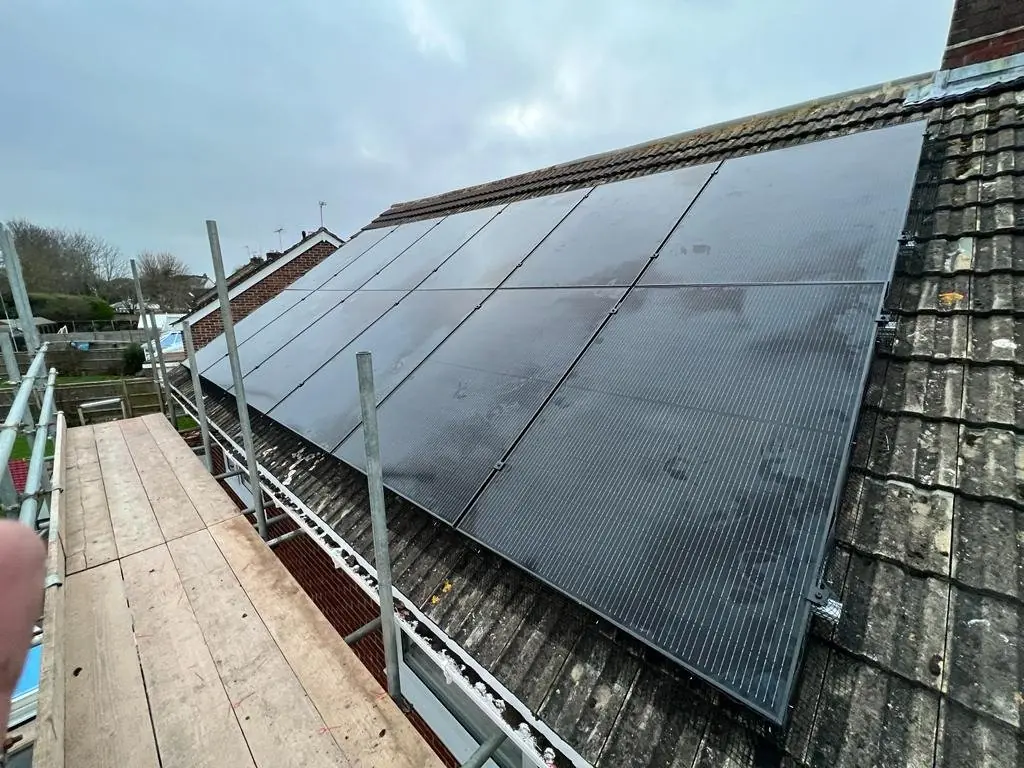
The best angle for solar panels in the UK is between 30 and 40 degrees from horizontal, facing as close to due south as your roof allows. Most homes sit at the upper end of that band, around 35 to 40 degrees, and anything within it generates close to the maximum a fixed array can manage here.
For how output changes through the year at any angle, see solar panel output by month.
The good news for almost everyone reading this: standard UK pitched roofs are already built at roughly that angle. You very rarely need to do anything clever.
What is the best angle for solar panels in the UK?
Panels produce most when sunlight hits the glass square on. The sun's height changes hour by hour and month by month, so a fixed panel can only ever be a compromise. The compromise that works best over a full year is tied to your latitude.
The rule of thumb is simple: take your latitude and subtract about 10 to 15 degrees. The UK runs from roughly 50 degrees north (the south coast) to 59 degrees north (Shetland), which lands the ideal fixed tilt somewhere between 38 and 43 degrees, with the practical sweet spot for output and cost sitting in the 30 to 40 degree band.
Why subtract anything at all? Because UK generation is heavily weighted towards summer, when the sun is high. Tilting slightly flatter than your latitude trades a little winter output, when there is barely any sunlight to collect anyway, for more of the summer sunshine that actually fills your meter.
Best angle by UK location
These figures are worked out from each city's latitude using the rule above. Treat them as guides rather than specifications. Cloud cover, local horizon and shading all shift the real answer, and a proper design uses PVGIS or MCS irradiance data for your exact postcode.
| Location | Latitude | Best fixed tilt (guide) |
|---|---|---|
| Southampton / Hampshire | 50.9°N | 38° |
| London | 51.5°N | 39° |
| Birmingham | 52.5°N | 39° |
| Manchester | 53.5°N | 40° |
| Newcastle | 55.0°N | 41° |
| Edinburgh | 55.9°N | 42° |
| Belfast | 54.6°N | 41° |
| Cardiff | 51.5°N | 39° |
Summer vs winter angle
The seasonal optima are much further apart than the regional ones. The usual working figures are your latitude minus 15 degrees for summer and your latitude plus 15 degrees for winter (PVGIS guidance). For a London roof that means roughly 36 degrees in summer and roughly 66 degrees in winter.
A 66 degree winter tilt is close to standing the panels on end. It catches the low December sun beautifully, and it would cost you badly through June and July.
Fixed installations use the year-round compromise because of where UK generation actually happens. Roughly three quarters of annual output lands between March and September, so an angle that favours summer beats one that favours winter, even if the winter figures look dramatic in isolation. There is a month by month breakdown in our guide to solar panel output by month in the UK.
Best direction: south, east, west or north
Direction (azimuth) matters more than tilt, and it is the part you usually cannot change.
| Roof faces | Output compared with due south |
|---|---|
| South | 100% |
| South east / south west | Around 95% |
| East / west | 15% to 20% less |
| North | Not recommended |
That is a smaller penalty than most people expect. An east-west split array, with panels either side of the ridge, also spreads generation across the morning and evening rather than spiking at noon, which often suits a household that is out during the day. There is more detail in our guide on whether solar panels need to face south.
North facing roofs are the one genuine no. The sun's path never favours them in the UK and the numbers do not stack up.
What if my roof isn't at the perfect angle?
Most UK roofs are pitched between 30 and 45 degrees, which puts them inside or within touching distance of the ideal band already. If your roof is at 32 degrees and the theoretical best for your postcode is 39, you are giving up a percent or two of annual output. On a typical 4kW system that is a few tens of kilowatt hours a year, worth a handful of pounds depending on your usage, generation and energy costs.
Compare that with the cost of a tilt frame, the extra wind loading, the visual impact and the planning questions that come with lifting panels off the roof plane, and flush mounting wins nearly every time. It is also kinder to your roof covering and your roof warranty.
For context on how small the geometry effects are, MCS irradiance data suggests that pointing up to 45 degrees away from due south costs under 6 percent of annual output. Roof angle and direction are simply not where systems are won or lost.
Where it does become worth a conversation is a very shallow pitch, under about 20 degrees. Shallow panels self-clean less well in rain, so dirt and pollen build up, and a modest tilt frame can be justified. Steep pitches over 45 degrees lose a little in summer but hold up better in winter, which can suit a home with a heat pump.
Flat roofs and ground mounts
Flat roofs are the one case where you choose the angle from scratch, and the answer is usually flatter than the theoretical optimum. Ballasted A-frames at 10 to 15 degrees are the standard on flat roofs because steeper frames catch far more wind, need much more ballast, and force wider row spacing so the front row does not shade the one behind. Squeezing in more panels at 12 degrees usually beats fewer panels at 38.
East-west "butterfly" layouts at a shallow tilt are increasingly common for the same reason. Our flat roof solar guide covers the mounting options in detail.
Ground mounted arrays are the exception where you really can hit the perfect number. There is no roof to work around, no wind uplift on a building, and the frame can be set to 38 to 42 degrees for your latitude. See ground mounted solar panels for the practicalities.
Does shading matter more than angle?
Yes, by a distance. A few degrees of tilt costs you low single figure percentages. A chimney, a dormer or a neighbour's sycamore shading part of the array through the afternoon can cost far more, because on a basic string inverter the shaded panel drags down the whole string it sits on.
That is what power optimisers and microinverters fix. Both let each panel work independently, so one shaded module stops the rest of the roof suffering. They add to the cost of the system, and on a genuinely clear roof they are not needed, so it is a design decision rather than a default. Our solar inverter guide explains the difference.
If you have shading, spend your money and your attention there rather than on angle.
Get your roof checked properly
Every roof is different, and the only way to know what yours will do is to have someone model it. CRG Direct offers a free roof survey across the South and South East. We measure the pitch and orientation, check the shading through the day, run the numbers for your postcode and give you a written estimate for your property rather than a national average. MCS Certified, HIES Accredited, installing since 2017.
Want a rough figure before you speak to anyone? Try our solar panel cost calculator, or read how long solar panels take to pay for themselves.
Call 0330 133 2497 or email info@crgdirect.co.uk to book a survey.
FAQs
Is 45 degrees too steep for solar panels?
No. A 45 degree roof is fine and plenty of UK houses have one. It is a few degrees steeper than ideal, which costs a little summer output and gives back a little in winter, and the net effect over the year is small. It also sheds snow and debris well.
Do east-west solar panels work in the UK?
Yes. An east or west facing array generates around 15 to 20 percent less than the same system facing south, according to Energy Saving Trust guidance. Because the output arrives earlier and later in the day, it can line up better with when you are actually at home using electricity, which affects how much of it you use yourself rather than export.
What is the best angle for solar panels in winter?
Roughly your latitude plus 15 degrees, so around 65 degrees in most of England and Scotland. That is only useful if you can physically adjust the array, such as a ground mount. On a fixed roof installation you are stuck with the pitch you have, and chasing winter sun is rarely worth it when December output is a fraction of June's regardless of angle.
Should I adjust my solar panel angle through the year?
Not on a roof. Seasonal adjustment means regular roof access, which is neither safe nor practical, and the gain is in the region of a few percent. On an accessible ground mounted frame, moving to a steeper winter setting and a shallower summer setting is a reasonable job to do twice a year if you fancy it.