
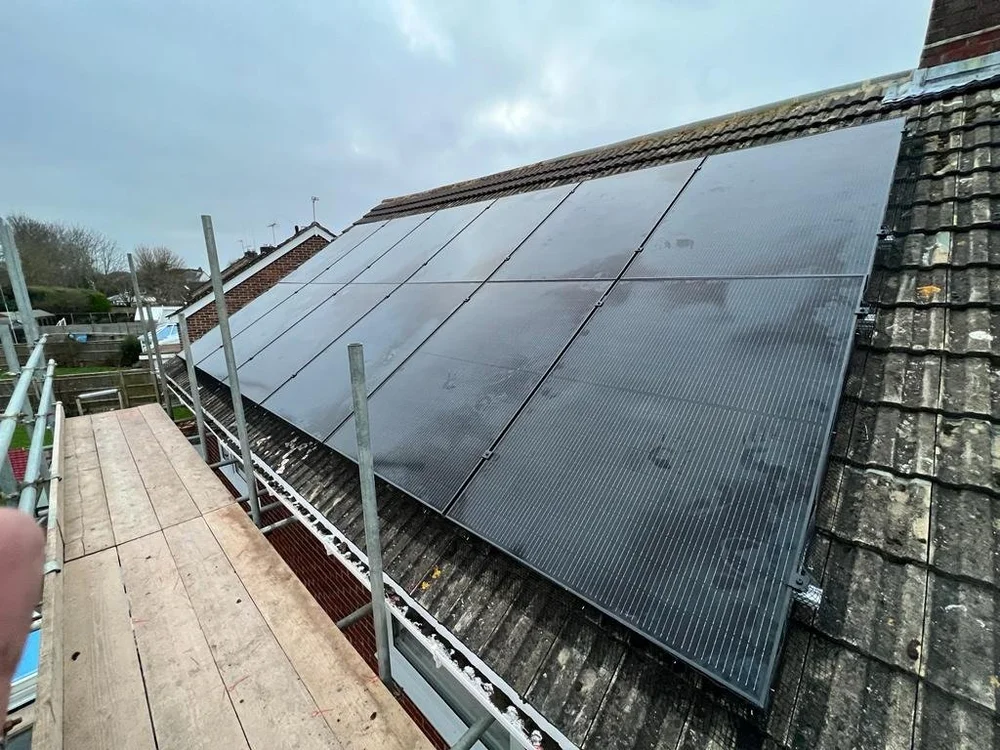
No. South-facing panels produce the most electricity in the UK, but east and west-facing roofs generate around 85% of that output, and for some households the east-west split actually works better in practice.
For how output changes through the year, see solar panel output by month. To get an instant price for your home, use our solar panel cost calculator.
The direction your roof faces affects how much your system generates. It doesn't determine whether solar is worth installing. For the full picture on tilt as well as direction, see our guide to the optimum angle for solar panels.
What the numbers look like
The UK sits in the northern hemisphere, so the sun tracks across the southern sky throughout the day. South-facing panels capture the most direct sunlight and produce the highest annual output. Every degree away from due south costs a small amount of generation:
| Orientation | Output vs south-facing |
|---|---|
| South | 100% |
| Southeast / Southwest | 95% |
| East / West | 85% |
| Northeast / Northwest | 65% |
| North | ~55% |
North-facing panels aren't recommended. At 55% of south-facing output, the system size required to generate meaningful savings pushes costs up to a point where other options make more sense.
When east or west works better
A south-facing system peaks around midday. Most households don't use much electricity then, since people are at work and appliances aren't running, and grid export rates may be lower than what you'd save by using the electricity yourself.
An east-west split generates earlier in the morning and later in the afternoon, which aligns better with how most homes actually use power. A household with two adults leaving for work at 8am and returning at 6pm captures more usable solar from an east-west system than from a south-facing one peaking at 1pm.
East-west installations also tend to have higher self-consumption rates, which matters because using your own solar electricity saves you more than exporting it earns. The more you use directly, the better the savings. For homes on time-of-use tariffs like Octopus Agile, spreading generation across more of the day adds further value.
Flat roofs
A flat roof gives you complete freedom over orientation and tilt. Most installers default to south-facing at 30-35°, which delivers optimal annual output. An east-west array at a lower angle (10-15°) is increasingly common on larger flat roofs, as two rows of panels facing opposite directions produce a broader generation curve, reduce wind loading, and suit households that want steady generation from morning to evening rather than a midday peak.
Making a non-south roof work
Size the system appropriately. If east or west-facing panels produce 85% of south-facing output, a slightly larger system (5kW instead of 4kW) closes most of that gap. The cost difference between a 4kW and 5kW system is typically £1,200-£1,800. See how many panels you need for sizing.
Add battery storage. A battery captures surplus generation whenever it occurs, which is especially useful on east-facing roofs that peak in the morning before household demand picks up. View our battery storage service.
Use power optimisers. On a single-string inverter, one shaded or poorly oriented panel drags down the whole string. Optimisers let each panel work independently, which matters more on east-west installations where different panels sit in shadow at different times of day.
Use both roof faces. A split array with panels on the east and west slopes of a ridge combines both advantages: higher total capacity and a spread-out generation profile. A single hybrid inverter can manage both strings.
Shading matters more than orientation
A south-facing roof with significant shading from a neighbouring building or mature trees will underperform a lightly shaded east-facing roof. Shade in the morning or evening cuts proportionally less generation than shade during peak midday hours, but any consistent shading that reduces a string's output needs to be factored into the design.
Before focusing on orientation, identify any shading that will affect the panels through the day and across seasons. Winter sun is much lower in the sky than summer sun, so a tree that casts no shadow in July may shade panels significantly from October to March. A thorough survey before installation catches this. A quote based on a satellite image or brief visit may not.
FAQ
My roof faces southeast. Is it worth installing panels? A southeast-facing roof at a standard pitch produces around 95% of south-facing output. Most homeowners with southeast-facing roofs still see sound payback at current electricity prices, depending on usage and generation. It's not a reason to avoid solar.
Can I put panels on both sides of my roof? Yes, and it's often the best configuration for semi-detached and detached houses. East and west slopes used together generate more total electricity than either alone, and the profile is better spread across the day. A good hybrid inverter handles both strings without issue.
Will a west-facing system work if I mostly charge an EV in the evening? West-facing panels suit evening EV charging better than south-facing ones. Generation peaks in the afternoon and continues into early evening, overlapping with when most people return home and plug in. Combined with a battery, you can store the afternoon's generation and use it to charge the car at 7-8pm.
Does orientation affect SEG payments? SEG pays per kWh exported at the same rate regardless of orientation. You'll export less from an east or west-facing system, but the rate per unit stays the same. Best fixed rates in 2026 reach around 25p/kWh, though top rates are limited and often conditional on buying your system from that supplier. Most widely-available rates are lower and change over time.
What if planning restrictions mean I can only use a non-south-facing roof? Conservation areas and listed buildings sometimes restrict panels on street-facing slopes. In those cases, rear-of-property installation on a non-optimal facing is usually permitted and still generates worthwhile output. An east or west-facing rear roof at 85% of optimal beats no system at all.
CRG Direct surveys every roof before recommending a configuration: orientation, shading, pitch and roof condition all go into the assessment. MCS Certified, HIES Accredited.
Contact us for a free site survey and quote. We'll respond within one working day.