

How to Choose the Right Size Solar Battery for Your UK Home
Solar panels and battery storage solve two different halves of the same problem. Panels generate electricity when the sun is out, and a battery holds onto what you don't use straight away so you can draw on it later, instead of buying it back from the grid at full price. For most homeowners installing solar, the real goal isn't "get a battery", it's cutting electricity bills, gaining some independence from rising energy prices, and maybe having power in a cut. Getting the battery size right is what decides whether you hit those goals or just add an expensive box to the wall.
For prices by battery type and size, see our guide to how much a solar battery costs in the UK, or get an instant price for your home.
This guide sets out the practical steps for choosing the right size solar battery for your home: how to read your own usage data, how to size for evening and overnight demand, how to plan for an electric vehicle or heat pump, and where to draw the line before you overspend on capacity you'll never use. Note this guide is about right-sizing battery storage alongside a grid connection, not going fully off-grid. Very few UK homes size a battery for true off-grid independence, since the winter generation shortfall makes it impractical without a much larger, more expensive system.
Quick Summary: Right Size and Solar Battery Sizing
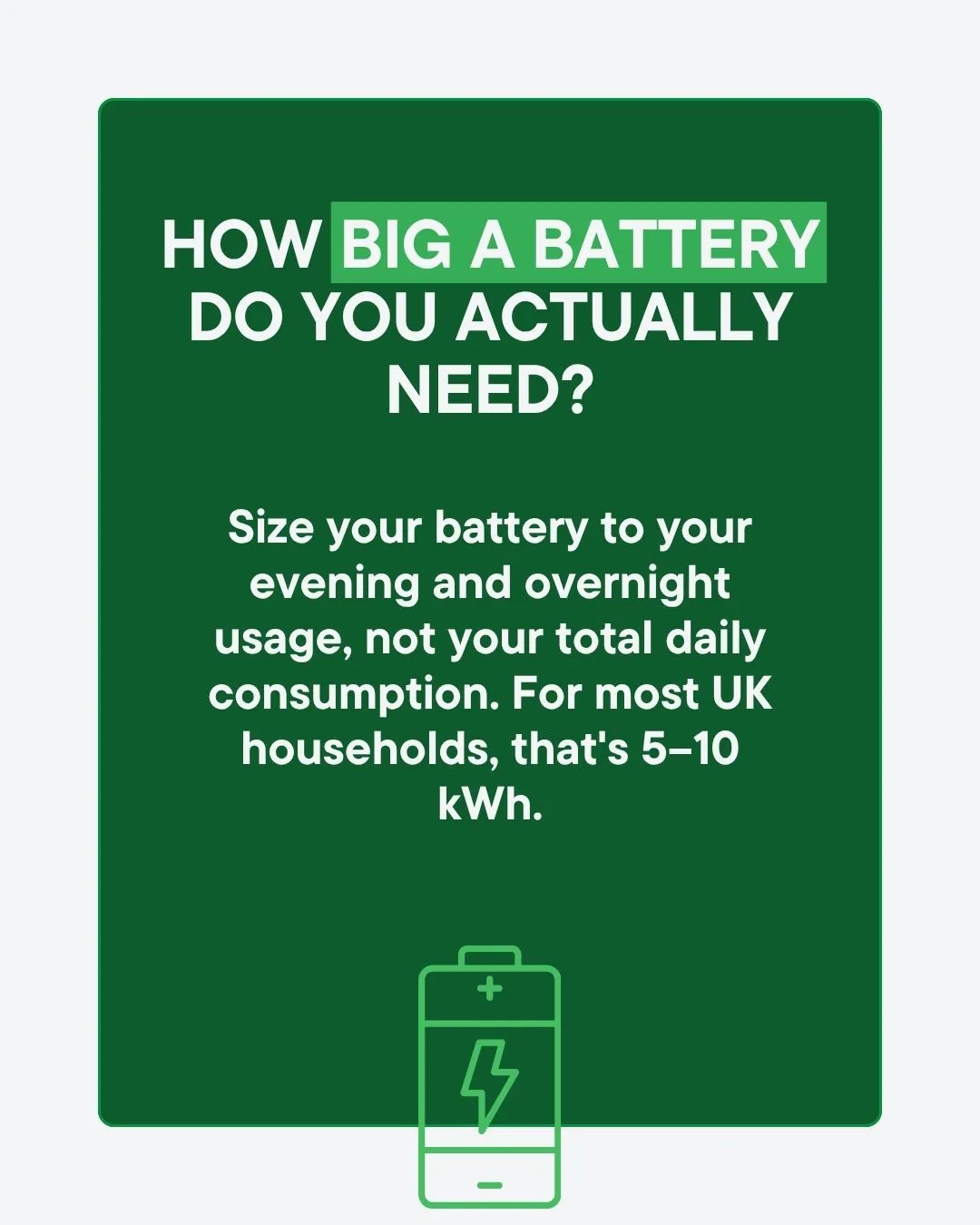
The rule of thumb: size your battery to match your evening and overnight electricity usage, not your total daily consumption. For most UK households that means a battery somewhere between 5 kWh and 10 kWh.
- Most UK households consume between 8 kWh and 10 kWh of electricity per day, with daily use ranging 4-12 kWh depending on household size and habits.
- A 9-10 kWh battery suits the average UK household and is the most common size bought in 2026.
- Smaller homes or flats often need only 5 kWh. Homes adding an EV charger or heat pump often need 10-16 kWh or more.
- A 4 kW solar panel system is typically paired with a 5-9.5 kWh battery, depending on how much of the day the household is out.
If you'd rather skip the maths, CRG Direct runs free site surveys that come back with a tailored battery-capacity recommendation based on your actual bills and roof, not a generic range. Book a survey.
Assess Your Electricity Usage Before Sizing
Before you talk to an installer, gather 12 months of electricity usage from your smart meter or supplier's online account. Most supplier apps hold at least a year of monthly kWh data, and that history matters more than a single recent bill because it captures both your summer and winter consumption.
Calculate your average daily kWh. Add the 12 monthly totals and divide by 365. UK households typically land somewhere between 4 kWh and 12 kWh a day. A couple who work from home during the day sits at the low end, a family running electric heating or home office equipment sits at the high end.
Identify your evening and overnight kWh usage. This is the number that actually drives battery sizing, not total daily consumption, but what you use once your panels stop generating (typically 4-6pm, earlier in winter) until they start again the next morning. For most households this window accounts for 60-70% of daily energy usage.
Note seasonal variation. UK solar generation is strong from April through September and drops off sharply from October to February. A battery that charges fully from solar every day in July might only reach 40-50% charge on a December day, because there simply isn't enough daylight surplus to fill it. Size around what your battery can realistically do in winter, not what it does at its summer best.
Calculate Evening Use and Peak Demand
Total the kWh you use between 16:00 and 23:00. If your supplier app or a device like Hildebrand Glow gives you half-hourly data, pull a typical week and add up the afternoon and evening readings. If you don't have that level of detail, a manual 7-day meter check works nearly as well. Read the meter at 16:00 and again at 09:00 each day, subtract, and average the week. That average is your target storage window.
Record peak single-appliance draws, not just totals. An electric oven pulls 2-3 kW. A kettle pulls 2-3 kW for a few minutes. A washing machine on a hot cycle pulls 1.5-2 kW. Your battery needs enough power output (kW), not just enough stored energy (kWh), to run these loads. Check the continuous power rating on any battery you're considering, usually 3-5 kW for a standard home unit.
If your calculation lands on, say, 8.5 kWh of evening use, a 9-10 kWh battery covers that comfortably once usable capacity and depth of discharge are factored in.
Include EV Charging and Future Loads
List any EV charging you already do, or plan to do, in kWh per day. The average UK driver covers roughly 20-25 miles a day. At 3-4 miles per kWh, that's 5-7 kWh of charge. If you charge at home overnight, this can add substantially to your evening load.
Estimate other future loads before they arrive, not after.
- A heat pump typically adds 2,000-4,000 kWh a year, concentrated in autumn and winter. If you're planning one through the government's Warm Homes Plan or a similar grant scheme, add this load to your battery sizing before the installation, not after
- A second EV roughly doubles home charging demand
- A hot tub or heated pool can add 3,000-5,000 kWh a year
Add the future-load estimate to your current baseline. If your evening usage today is 7 kWh and an EV will add 6 kWh of overnight charging, your effective target becomes 13 kWh, not 7. A common planning rule is to add 30-50% extra capacity if electrification (EV charger, heat pump, or both) is part of your plan over the next five years. Sizing for today and expanding later usually costs more overall than sizing correctly from the start.
Match Battery Capacity to Your Solar System
A battery can only store the surplus your solar panels generate above whatever you're using in real time. If your array doesn't produce enough surplus, the battery ends up topping up from the grid, which changes the economics of the whole system.
Check your solar panels' expected daily generation, by month if possible. Your installer should be able to give you this, but as a rough guide, a 4kWp system in southern England generates approximately:
- June/July: 18-22 kWh/day
- April-May and August-September: 12-16 kWh/day
- October/March: 6-10 kWh/day
- November-February: 3-6 kWh/day
Work out your average daily solar surplus. Subtract your consumption during daylight hours (what you use while panels are generating, typically 30-40% of daily total if the house is empty during the day, 50-60% if someone's home) from your generation figure. What's left is available to charge the battery.
Compare that surplus to the battery capacity you're considering. A 4kWp array producing 14 kWh on a spring day, against 5 kWh of daytime use, leaves 9 kWh of surplus, and a 10 kWh battery captures nearly all of it. But if your panels only generate 7 kWh of surplus and you're looking at a 15-16 kWh battery, you'll never fill it from solar alone. You'd be relying on off-peak grid charging instead, which is a different sizing conversation entirely.
Estimate Usable Battery Capacity and DoD
The number on the spec sheet, nominal capacity, isn't what you actually get to use.
Depth of Discharge (DoD) sets how much of that nominal capacity is accessible. Most modern LiFePO4 batteries run a DoD of 90-95%, so a 10 kWh battery gives you roughly 9-9.5 kWh of usable capacity. Older lithium-ion (NMC) units can sit lower, down toward 80%. Always check the datasheet rather than assuming. We cover this in more detail in our guide to depth of discharge and battery lifespan.
Inverter power rating shapes how fast you can draw that stored energy. A 5 kWh battery with a 2 kW continuous output can run a 2 kW load for around 2.5 hours. The same battery with 3.6 kW output handles a heavier appliance more comfortably but drains faster under load. If your household has a high simultaneous peak demand, several big appliances running at once, confirm the battery's continuous power output before committing to a model.
Apply a Practical Rule of Thumb for Sizing
When the full calculation feels like more than you need, these benchmarks cover most UK households reasonably well:
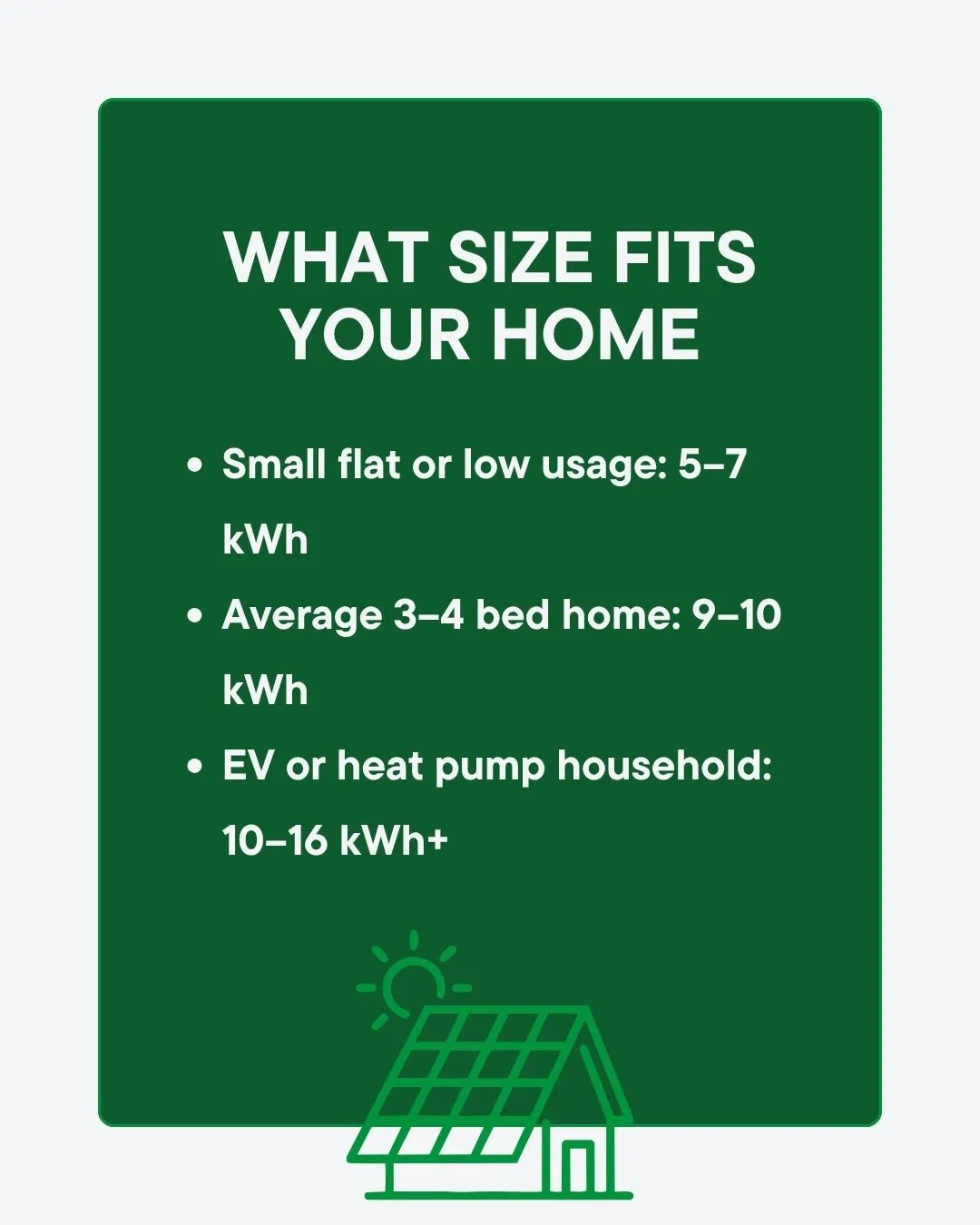
- Battery capacity ≈ your evening and overnight kWh usage. An 8 kWh evening load pairs well with a 9-10 kWh nominal battery.
- Battery capacity ≤ daily solar surplus, if your panel array is small. A 13 kWh battery on a modest, shaded, or north-east-facing array is capacity you'll rarely fill. Size down to what the panels can realistically deliver.
- Typical UK benchmark ranges:
| Annual Consumption | Recommended Battery |
|---|---|
| Under 2,500 kWh | 5-7 kWh |
| 2,500-3,500 kWh | 7-10 kWh |
| 3,500-5,000 kWh | 10-13 kWh |
| Above 5,000 kWh, or with an EV | 13-20 kWh |
Sizing for Emergency Backup Power and Backup Power Needs
Not everyone needs backup power, but for households in areas with frequent power outages, or with medical equipment or home offices that can't tolerate downtime, it's a real requirement that changes your sizing decision.
Decide between whole-home and partial backup. Whole-home backup keeps every circuit running and needs a larger battery plus a higher-rated inverter. Partial backup covers a smaller critical-load panel, usually lighting, the fridge, a handful of sockets, and broadband, and can be handled by a smaller system if you identify those circuits in advance.
List the circuits you'd want to keep running in an outage, and total their draw over the outage length you're planning for. For 12 hours covering a fridge (1.5 kWh), lighting (0.5 kWh), broadband (0.2 kWh), and a medical device (2 kWh), that's 4.2 kWh of reserve, kept separate from the capacity you're counting on to cover normal evening use.
How Much Extra Capacity for Emergency Backup Power
Add 20-40% on top of your baseline sizing to hold a backup reserve. If your evening-use calculation points to a 9 kWh battery and you want a 3-4 kWh reserve for outages, a 13 kWh battery covers both.
Size the inverter for the emergency load in kW, not just kWh. Running a fridge, lighting, and a boiler pump together (around 1.5 kW) is well within a standard 3.6 kW battery inverter. Running a full electric cooker during an outage (8-10 kW draw) needs a considerably more powerful hybrid inverter, so confirm this with your installer before it's specified.
Confirm the system supports genuinely seamless backup. Some batteries pause for 20-30 milliseconds when switching to backup mode, enough to reboot a router or reset a clock. True uninterruptible backup (zero transfer time) needs hardware rated specifically for it, and not every system on the market offers it. If continuity matters to you, say so at the survey stage rather than assuming it's included.
Consider EV Charging Strategies With Battery Storage
Whether your battery should supply EV charging, or the car should charge straight from cheap off-peak grid electricity, depends on your tariff.
If you're on a time-of-use tariff with cheap overnight rates (some fall to 7-10p/kWh overnight during off-peak hours), charging the EV from the grid at night is usually cheaper than draining the battery to do it. Leave the battery to serve household loads instead, and you don't need to build EV demand into its sizing at all.
If you want the EV to run on stored solar rather than grid electricity, the battery needs to cover both household evening use and the charge itself. A household using 8 kWh in the evening, wanting to add 7 kWh of solar-charged EV top-up, needs at least 16-18 kWh nominal capacity.
Model the daily kWh impact using your smart charger's app or your EV's efficiency rating and typical mileage, and have that figure ready before your survey so the installer can factor it into the recommendation rather than guessing.
Cost, Payback, and Financing Choices
Battery capital cost per usable kWh typically runs £400-£700 installed in 2026, depending on brand, chemistry, and installation complexity. Solar battery prices as a whole span roughly £1,500-£10,000 depending on size: a 5 kWh system costs around £4,600, and a 10 kWh LiFePO4 system usually lands between £4,000 and £6,000 fully installed. Battery installations also carry 0% VAT in the UK, which reduces the headline cost against a standard-rated product. For a fuller breakdown, see our guide to solar battery costs in the UK.
Model payback against your current tariff. If the battery saves you 8 kWh a day at 26p/kWh, that's about £2.08 a day, or roughly £760 a year, depending on your usage, generation and energy costs. On a £5,000 battery, simple payback lands around 6.5 years, faster if electricity prices climb, slower if the battery is oversized and never fills.
Financing options worth comparing:
- Cash purchase: fastest payback, no interest
- 0% finance: CRG Direct offers interest-free finance for qualifying customers, with repayments that often roughly offset year-one electricity savings
- Personal loan: typically 6-9% APR over 3-7 years, still often worthwhile against rising electricity prices
- Combined solar-and-battery install vs. later retrofit: fitting the battery alongside new solar panels is cheaper than adding it afterwards. If you're installing solar now, size the battery into the same job
Physical Constraints: Installation, Space and Inverter Compatibility
Check the space you actually have. A typical battery system measures around 100cm x 60cm x 25cm and mounts on a wall bracket, so a loft, garage, utility room, or understairs cupboard usually works. LiFePO4 batteries tolerate unheated spaces reasonably well (roughly -10°C to 50°C), though performance drops below freezing, so check the manufacturer's spec against your intended location.
Confirm your inverter matches the battery chemistry. LiFePO4 and NMC batteries need different charging profiles, and not every inverter supports every battery brand. If you're retrofitting a battery to an existing solar inverter, this compatibility check has to happen before you buy, either a hybrid inverter that manages both, or a compatible AC-coupled setup.
Verify gateway and export control compatibility. Where your DNO requires an export limitation device, common on larger systems, check the battery's management system works with it natively, or whether it needs a separate gateway. A mismatch here can hold up grid connection approval.
Chemistry, Warranty and Lifespan Considerations for Battery Storage
LiFePO4 vs. NMC lithium-ion:
| Factor | LiFePO4 | NMC |
|---|---|---|
| Thermal safety | Excellent | Good |
| Energy density | Lower | Higher |
| Cycle life | 4,000-6,000+ cycles | 2,000-3,000 cycles |
| Typical lifespan | 10-12 years, up to 15 with good care | 8-10 years |
| Cost | Slightly higher per kWh | Slightly lower per kWh |
Check warranty terms line by line, not just the headline years:
- Coverage length: 10 years is standard, some manufacturers offer 12
- Throughput guarantee, expressed in MWh cycled. A 10 kWh battery with a 36 MWh guarantee covers roughly 10 full cycles a year for 10 years, which is enough for most homes
- End-of-warranty capacity: most manufacturers guarantee 70-80% of original capacity by the time the warranty runs out
Plan for eventual replacement. Regular maintenance and keeping the battery in a temperature-controlled space both help it reach the top end of its expected lifespan. At 10-15 years, degraded capacity makes replacement worth considering, and by then battery prices will likely reflect that era's technology costs, so budget loosely for it now rather than being surprised later.
Future-Proofing and Expandability for Solar Energy Systems
Decide up front whether you want room to expand. Some battery systems are modular, so you install one unit now and add modules later as usage grows. Others are fixed-capacity and require full replacement to add storage. If an EV, heat pump, or growing family usage is likely, a modular system avoids replacing an undersized unit down the line.
Check what your inverter allows for stacked batteries. Hybrid inverters have a maximum battery capacity they can manage. A 5 kWh battery on an inverter rated to 20 kWh has clear room to grow, while an inverter capped at 10 kWh is a ceiling you'll hit without replacing the inverter itself.
Map out EV and heat pump adoption timelines now, even loosely. If an EV is two years out and a heat pump five years out, it's usually cheaper to specify slightly more capacity today than to run two separate expansion projects later.
Can You Add More Battery Later?
Yes, but it costs more than getting the size right the first time. Adding a module to an expandable system typically runs £1,500-£3,000 per additional kWh once the installer visit, hardware, and updated commissioning are included, costs that would have been shared across a larger original install. We go deeper on this in our guide to adding a battery to an existing solar system.
The practical guidance: if you're torn between two sizes and an EV or heat pump is genuinely likely within five years, go with the larger battery now. The extra upfront cost is usually recovered within 2-3 years through the larger system's improved performance, depending on your usage and energy costs. If the bigger system is a significant stretch and the future load is still speculative, install the right size for today on a system that supports expansion, and revisit when the load actually arrives.
Sizing Examples and Benchmarks
Example 1: Small terrace, 2,700 kWh/year Average daily usage: 7.4 kWh. Evening/overnight share (about 65%): 4.8 kWh. Solar surplus from a 3kWp array in spring/summer: roughly 6 kWh. No EV, no heat pump. Recommended: 7-8 kWh nominal. At 90% DoD that delivers roughly 6.75 kWh usable, enough for most evenings with headroom for seasonal dips.
Example 2: Three-bed semi, 3,400 kWh/year Average daily usage: 9.3 kWh. Evening/overnight share: 6 kWh. Solar surplus from a 4kWp array: 8-9 kWh on spring/summer days. No EV yet, but planned within three years. Recommended: 9-10 kWh nominal, on an expandable system. A 9.5 kWh LiFePO4 battery at 90% DoD gives about 8.5 kWh usable, which covers current evening use and leaves room to add a module when the EV arrives.
Example 3: Four-bed detached, EV household Total annual consumption: 5,200 kWh, including an existing EV adding roughly 1,800 kWh/year. Household evening use: 7.5 kWh. EV charge from home battery: 6 kWh. Combined target: 13.5 kWh. Solar array: 6kWp, generating 10-12 kWh surplus on an average spring day. Recommended: 13-16 kWh nominal. A 15 kWh LiFePO4 system at 90% DoD gives 13.5 kWh usable, which covers both loads, with winter heat pump demand worth a separate check if one's added later.
How to Work With an Installer (CRG Direct Guidance)
Request a free site survey from CRG Direct. Bring your 12-month usage data, any half-hourly smart meter exports you can pull from your supplier's app, and a note of planned future loads. The survey covers roof assessment, shading, inverter and battery compatibility, and DNO requirements, and comes back with a written specification and cost breakdown at no charge and no obligation.
Ask for detailed generation modelling, not just a battery size. A credible installer shows estimated monthly solar generation, expected self-consumption with and without the battery, and projected annual savings. If a quote skips this, ask for it before you sign anything.
Get more than one quote and compare the equipment, not just the price. Two similar-sounding quotes can differ hugely in battery chemistry, inverter quality, warranty terms, and installation scope. Ask each installer to specify: battery brand and model, nominal and usable kWh, continuous power output, DoD, warranty length and throughput guarantee, and whether the system is expandable, then compare those line by line.
Checklist: Steps to Choose the Right Size Solar Battery
- Collect 12 months of electricity bills or smart meter data
- Calculate daily and evening/overnight kWh usage
- Measure your solar panels' average daily generation across the seasons
- Decide on emergency backup and EV charging needs
- Select battery capacity after applying the rule of thumb
- Confirm physical fit and inverter compatibility
- Get CRG Direct or another certified installer to quote, and compare equipment line by line
Common Questions
What size battery do I need? Most 3-4 bedroom UK homes use 8-10 kWh a day. If 60-65% of that falls in the evening and overnight window, that's 5-7 kWh of storage needed. A 9-10 kWh nominal battery at 90% DoD delivers roughly 8.5-9 kWh usable, which covers most evenings comfortably. Smaller households under 2,500 kWh a year usually only need 5-7 kWh.
What does battery capacity actually mean? A 10 kWh battery holds a maximum of 10 kilowatt-hours. A 1 kW appliance running flat out for 10 hours would drain it completely. Depth of Discharge limits mean you typically access 90-95% of that figure in practice, so around 9-9.5 kWh, which is enough to cover a household's evening lighting, TV, fridge, and the odd kettle or washing machine cycle through most of the night.
Why does oversizing or undersizing reduce value?
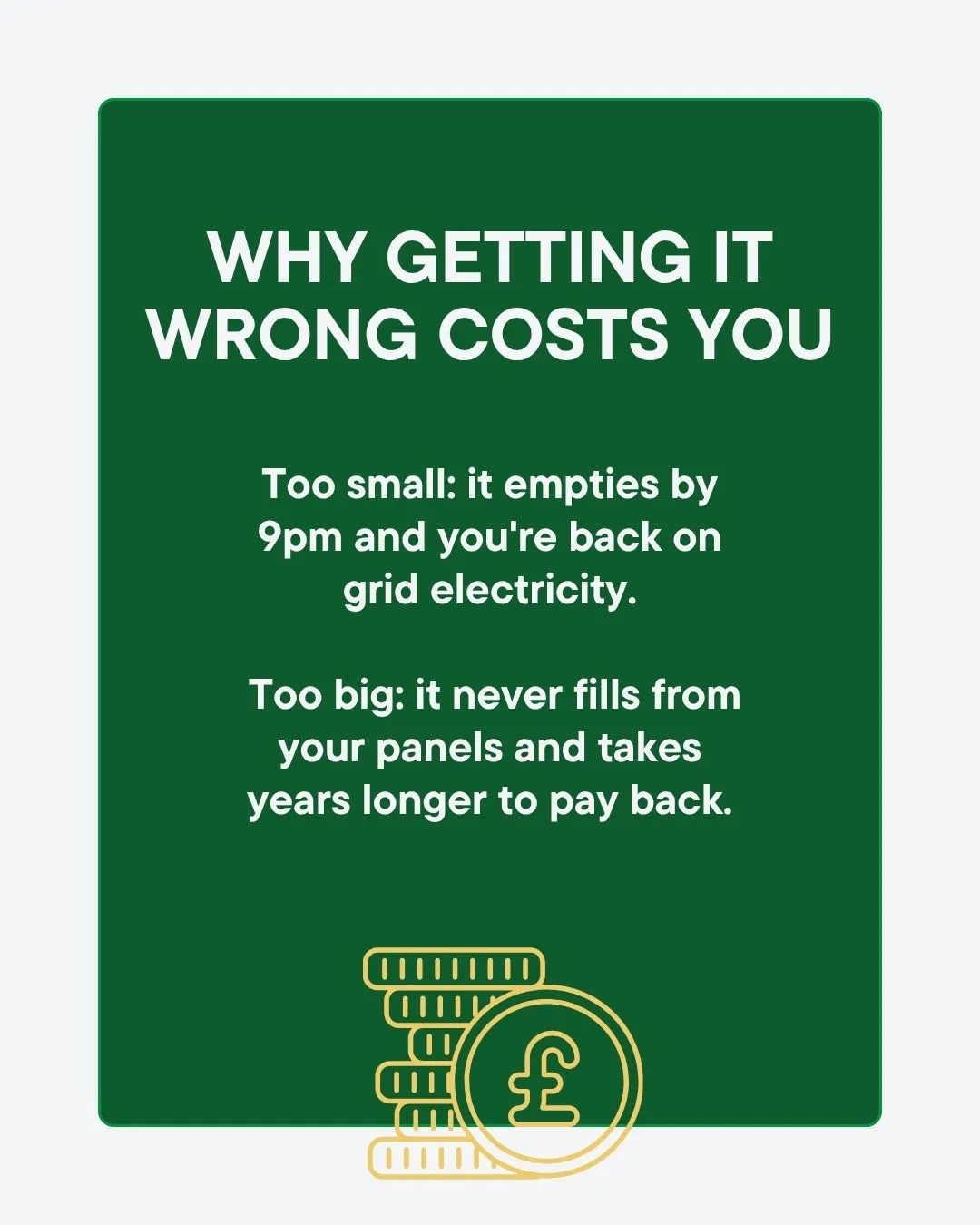
An undersized battery fills early in the afternoon, starts exporting cheap electricity before your evening demand even peaks, and runs dry well before morning, leaving you buying grid electricity at full price for the hours it should have covered. An oversized battery rarely charges to full from your panels, may need expensive grid electricity to top up, and stretches your payback period for no extra benefit over a properly sized unit. Either way, you end up paying more for a result a correctly sized battery would have delivered for less.
Final Notes and Next Steps
Sizing a solar battery correctly comes down to your actual usage data, not guesswork. The calculation itself takes maybe half an hour once you've got 12 months of bills and a meter reading habit. What an installer adds on top is generation modelling for your specific roof, equipment knowledge, and an understanding of how local DNO rules and tariffs affect the right configuration for your address.
CRG Direct offers free, no-obligation site surveys that come back with a tailored battery sizing recommendation and a full system specification. Book at crgdirect.co.uk/quote or call +44 330 133 2497.
If you would like a survey, see how CRG Direct's battery storage service works.
Sources
- Ofgem, Smart Export Guarantee (SEG): official scheme page
- HMRC, 0% VAT on energy-saving materials: official guidance
- MCS Certified Installer Register: mcscertified.com