
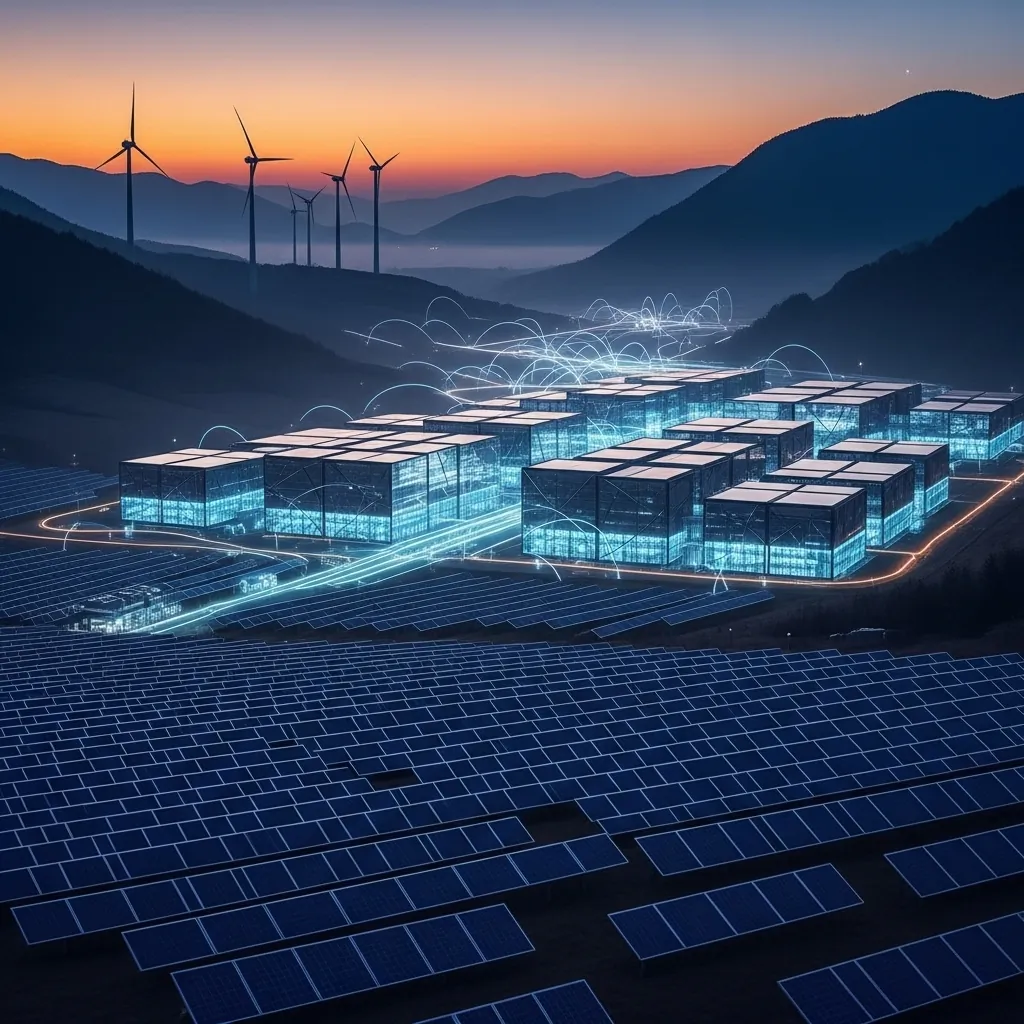
The digital revolution has created an unprecedented challenge for the clean energy transition. By 2030, data centers alone will consume an additional 44 GW of electricity, equivalent to the entire power generation capacity of South Korea. This massive surge in demand, driven by artificial intelligence, cloud computing, and digital transformation, is creating a race between renewable energy deployment and digital infrastructure growth. The outcome will determine whether our digital future is powered by clean energy or becomes a roadblock to decarbonization.
The Digital Energy Explosion
The numbers are staggering and growing exponentially:
The exponential growth of digital energy consumption across key sectors
Current Energy Consumption
- Global data center energy use: 205 TWh annually (2022)
- Percentage of global electricity: 1.3% of total consumption
- AI training models: Single large model can consume 1,000 MWh
- Cryptocurrency mining: 120-150 TWh annually
- Additional data center demand: 44 GW globally
- AI-driven demand: 26-33 GW in 2024 scaling to 60-80 GW by 2030
- Cleantech manufacturing: 11 GW additional industrial demand
- Direct air capture: 2.7 GW for carbon removal facilities
- GPT-3 training: Consumed 1,287 MWh
- GPT-4 estimated consumption: 10,000-50,000 MWh for training
- Continuous training: Models require regular updates consuming additional energy
- Research and development: Experimental models consume massive energy during development
- ChatGPT daily operations: Estimated 564 MWh daily
- Google's AI services: Significant portion of 22.7 TWh annual consumption
- Enterprise AI deployment: Growing rapidly across all industries
- Edge AI processing: Distributed computing increasing total demand
- Hyperscale facilities: 800+ facilities globally, growing 20% annually
- Edge computing: Thousands of smaller facilities closer to users
- Colocation facilities: Shared infrastructure driving efficiency
- Private data centers: Enterprise facilities for sensitive workloads
- Northern Virginia: World's largest data center market
- Silicon Valley: Concentrated tech infrastructure
- Ireland: European data center hub
- Singapore: Asia-Pacific regional center
- 24/7 carbon-free energy by 2030
- 5 GW renewable energy contracted globally
- Advanced geothermal investment and development
- Carbon-free matching for all operations
- Carbon negative by 2030
- 1 GW renewable energy procurement program
- Nuclear energy partnerships and investments
- Sustainable data center design innovations
- 15.7 GW renewable capacity globally
- Largest corporate purchaser of renewable energy
- 100% renewable energy by 2025
- Climate Pledge commitment to net-zero by 2040
- Hourly matching of renewable generation to consumption
- Advanced analytics to optimize energy timing
- Storage integration for round-the-clock clean power
- Grid services providing system-wide benefits
- 15-25 year agreements providing developer certainty
- Largest-ever renewables deals breaking procurement records
- Portfolio approach combining multiple technologies
- Geographic diversity reducing weather and policy risks
- 7-year average to connect new generation to the grid
- Interconnection queues with 2,000+ GW of projects waiting
- Grid modernization requirements for distributed resources
- Regional variations in grid capacity and renewable resources
- Local grid upgrades required for large data centers
- Substations and transformers limiting capacity
- Power quality requirements for sensitive equipment
- Reliability standards for mission-critical operations
- Texas wind and solar abundant but transmission-limited
- California solar with storage requirements
- Midwest wind with seasonal variations
- Southeast nuclear providing baseload complementarity
- Permitting processes varying by state and region
- Renewable energy standards driving local procurement
- Grid interconnection rules affecting project viability
- Carbon pricing influencing technology choices
- Direct-to-chip cooling reducing energy by 30-40%
- Immersion cooling for high-density computing
- Waste heat recovery for district heating systems
- Free cooling using ambient air when possible
- Google's DeepMind reducing cooling energy by 40%
- Predictive maintenance preventing equipment failures
- Dynamic load balancing optimizing energy consumption
- Machine learning for continuous optimization
- Rooftop solar on data center facilities
- Battery storage for backup and grid services
- Fuel cells for reliable clean power
- Microgrids for greater energy resilience
- Solar + storage for daytime peak shaving
- Wind + storage for 24/7 renewable power
- Geothermal for consistent baseload generation
- Hydrogen for long-duration backup power
- 600 GW annual capacity by 2025
- Domestic manufacturing driven by policy incentives
- Technological improvements increasing efficiency
- Cost reductions through scale economies
- 125 GW annual installations globally
- Offshore wind expansion for coastal data centers
- Larger turbines improving capacity factors
- Supply chain localization reducing transportation costs
- 170 GWh annual production capacity
- Gigafactory construction worldwide
- Technology diversification beyond lithium-ion
- Recycling infrastructure for sustainable supply chains
- Record project sizes exceeding 1 GW
- Integrated generation and storage becoming standard
- Merchant development responding to market signals
- Corporate partnerships enabling faster deployment
- Behind-the-meter systems for demand management
- Community solar for shared renewable access
- Agrivoltaics combining farming and energy generation
- Floating solar utilizing water bodies for generation
- 24/7 operation requiring baseload characteristics
- High power density concentrating demand geographically
- Predictable patterns enabling better grid planning
- Quality requirements for sensitive computing equipment
- Load shifting during peak pricing periods
- Demand response for grid emergencies
- Thermal storage in cooling systems
- Computational load balancing across facilities
- Aggregated demand response from multiple data centers
- Coordinated storage systems providing grid services
- Automated participation in frequency regulation
- Revenue generation from grid service participation
- Campus-scale energy systems
- Islanding capability for grid outages
- Peer-to-peer trading between facilities
- Resilience enhancement through distributed generation
- Long-term contracts providing price certainty
- Renewable energy offering low and stable costs
- Hedging strategies against fossil fuel volatility
- Efficiency improvements reducing total consumption
- AI optimization reducing energy waste
- Advanced cooling improving power usage effectiveness
- Load management reducing peak demand charges
- Predictive maintenance preventing costly outages
- Carbon neutrality commitments attracting customers
- ESG performance improving investor relations
- Brand differentiation in competitive markets
- Regulatory compliance reducing operational risks
- Clean energy expertise enabling new services
- Grid integration creating revenue opportunities
- Technology leadership in sustainable computing
- Partnership opportunities with renewable developers
- Scale up renewable energy contracting
- Diversify technology portfolios
- Invest in grid infrastructure
- Collaborate on shared solutions
- Advance cooling technologies
- Implement AI optimization
- Develop next-generation hardware
- Optimize software efficiency
- Streamline interconnection processes
- Modernize grid infrastructure
- Support renewable development
- Incentivize efficiency improvements
- Reduce financing barriers
- Provide loan guarantees
- Fund research and development
- Support demonstration projects
Projected Growth by 2030
This translates to more than 57 GW of new "always-on" electricity demand by 2030, a 28% increase in total U.S. electricity consumption if trends continue.
The AI Revolution's Energy Appetite
Artificial intelligence is the primary driver of this energy surge, with implications that extend far beyond data centers:
AI's Energy Requirements
Training Large Language Models:
AI Inference and Deployment:
Visualization showing the massive energy requirements of AI training and inference
The Compounding Effect
Data Center Proliferation:
Geographic Concentration:
Clean Energy Procurement: The Corporate Response
Tech companies are responding to this challenge with the largest corporate renewable energy procurement program in history:
Record-Breaking Procurement
Google's Commitment:
Microsoft's Approach:
Amazon's Scale:
New Procurement Models
24/7 Carbon-Free Energy:
Long-term Contracts:
The Infrastructure Challenge
Meeting this demand requires unprecedented infrastructure development:
The complex infrastructure needed to support massive data center energy demands
Grid Capacity Constraints
Transmission Bottlenecks:
Distribution Challenges:
Regional Dynamics
Renewable Resource Availability:
Policy and Regulatory Environment:
Innovation in Data Center Design
The industry is responding with revolutionary approaches to data center efficiency and sustainability:
Advanced Cooling Technologies
Liquid Cooling Systems:
AI-Optimized Operations:
On-Site Generation and Storage
Integrated Renewable Systems:
Hybrid Solutions:
The Supply Chain Response
The renewable energy industry is rapidly scaling to meet this unprecedented demand:
Manufacturing Capacity Expansion
Solar Manufacturing:
Wind Turbine Production:
Battery Manufacturing:
Project Development Acceleration
Utility-Scale Projects:
Distributed Generation:
Grid Integration Challenges
The scale of data center demand is forcing fundamental changes to grid operations:
Load Characteristics
Constant Demand:
Flexibility Potential:
Grid Services Innovation
Virtual Power Plants:
Microgrid Development:
The Competitive Advantage
Companies that successfully navigate this challenge will gain significant competitive advantages:
Cost Management
Energy Price Stability:
Operational Efficiency:
Market Positioning
Sustainability Leadership:
Innovation Capacity:
The Path Forward
Meeting the 44 GW challenge requires coordinated action across multiple stakeholders:
Industry Actions
Aggressive Procurement:
Efficiency Innovation:
Policy Support
Regulatory Reform:
Investment Facilitation:
Conclusion: Racing Toward a Sustainable Digital Future
The 44 GW data center challenge represents both a crisis and an opportunity. If managed poorly, the explosive growth of digital infrastructure could undermine global climate goals. If managed well, it could accelerate the clean energy transition and create a more sustainable, resilient energy system.
The scale of corporate renewable energy procurement driven by data centers is unprecedented. Tech companies are becoming the largest drivers of renewable energy development, with procurement programs that dwarf many countries' entire renewable energy capacity. This demand is creating market certainty that enables large-scale clean energy investment.
The innovation being driven by this challenge is remarkable. From AI-optimized operations to advanced cooling systems to hybrid renewable energy solutions, the data center industry is pushing the boundaries of energy efficiency and sustainability. These innovations will benefit not just data centers but the entire energy system.
The race is on. Data center energy demand is growing exponentially, but renewable energy deployment is accelerating to meet it. The outcome will determine whether our digital future is powered by clean energy or becomes a barrier to decarbonization. The early signs are encouraging. Record-breaking renewable energy procurement, revolutionary efficiency improvements, and unprecedented policy support are all pointing toward a sustainable solution.
The 44 GW challenge is massive, but it's also an opportunity to transform our energy system. By driving demand for clean energy, improving efficiency, and accelerating innovation, the data center industry could become a catalyst for the clean energy transition rather than an obstacle to it. The digital revolution and the clean energy revolution are converging, and the results will shape our planet's future for generations to come.
Ready to power your digital infrastructure with clean energy? Contact us to learn how renewable energy solutions can transform your data center operations today.